Sumit Bhateja Off duty / beyond the desk Drag the photos around

Beyond the desk

Badminton keeps the reflexes sharp. Books keep the attention long. Motorcycles keep me humble on mountain passes.

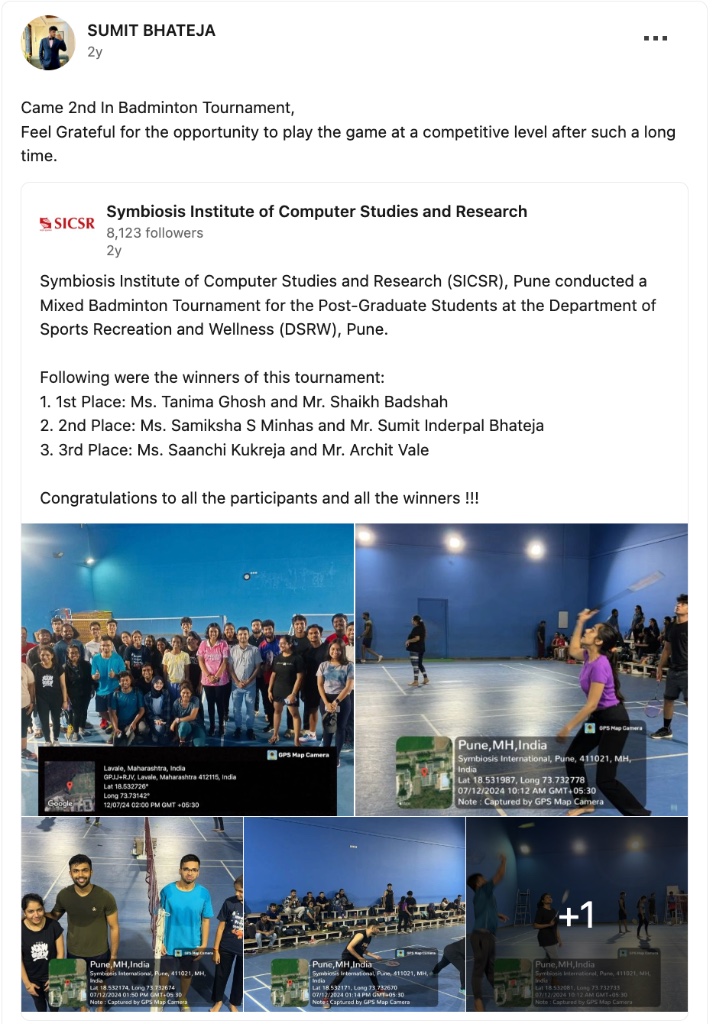
Sumit at a badminton tournament
Rally mode
Sumit on a motorcycle ride
Highway mode
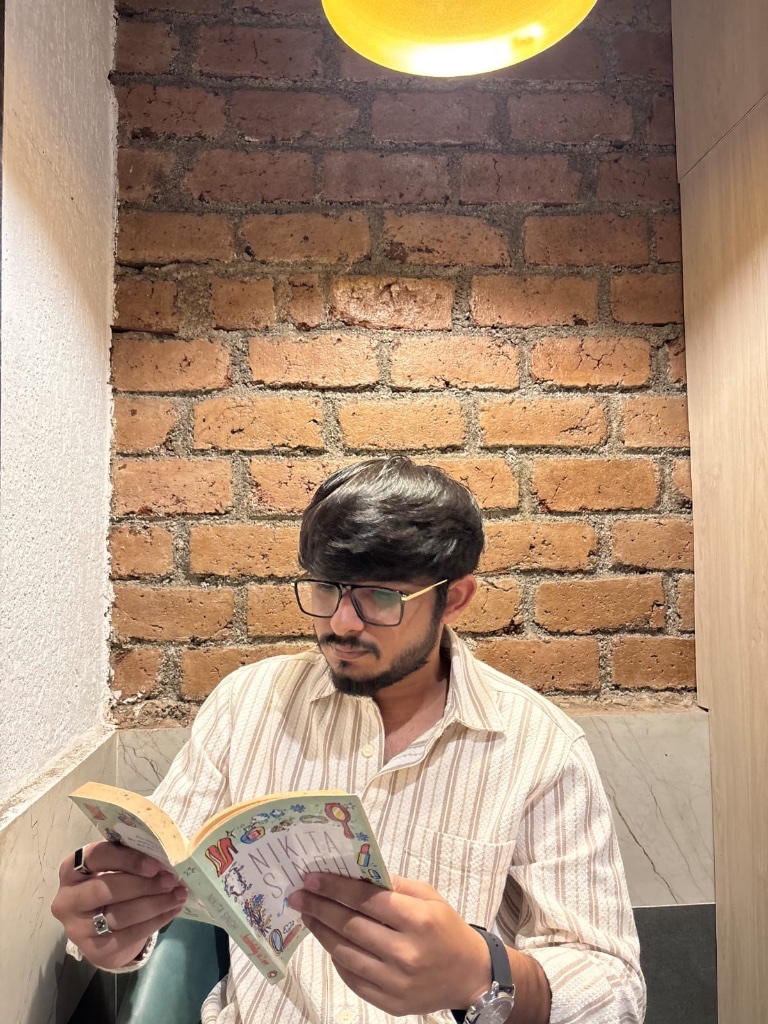
Sumit reading
Do not disturb
Off duty
01 / Competitive badminton

Keep the rally alive.

Competed in the post-graduate mixed badminton tournament run by SICSR at the Department of Sports Recreation and Wellness, Pune. The sport is all anticipation, split-second calls and stamina under pressure. Sound familiar?

Your rally{{ rally }}
Best{{ best }}
See the tournament post↗
Click the shuttle
02 / Reading + philosophy

Screen-free hours.

Business strategy, leadership philosophy and modern fiction. Quiet reading time builds deep attention and lateral thinking, which turns out to be useful when a client's problem doesn't fit the template.

Strategy Leadership Philosophy Fiction Sales craft Systems
Sumit reading a book
Deep focusPhone in the other room
03 / Motorcycle touring

Twist the throttle.

Long highway tours and mountain rides. Passes, unfamiliar terrain and weather that changes its mind all demand grit, awareness and calm adaptability.

Scrolled on this page{{ km }} km

Sumit on a mountain motorcycle ride
Mountain trailsHelmet on
Mini game / Ghat road run Hop the rocks. Don’t brake.
This ride{{ ride }} km
Longest{{ rideBest }} km
Tap, click, space or up arrow to jump

Rally, read or ride?

Up for a match, a book swap or a route recommendation? Same inbox as the serious stuff.

Challenge me Swap books Plan a ride
Shelf note 01 / Strategy

Win before the battle

The idea from The Art of War I use every week: the deal is mostly decided before the meeting starts. I don’t walk into a call cold.

Before I speak to anyone, I research their business, work out the problem they’re facing or about to face, decide how we would solve it, and line up the resources and proof we can show them. By the time we talk, the call confirms what they already suspect instead of starting from zero.

Book that shaped thisThe Art of War, Sun Tzu
“The victorious strategist only seeks battle after the victory has been won.”
Shelf note 02 / Leadership

Deals and the long game

In business development, the temptation is to close. Push hard, get the signature, move on. Covey's Think Win-Win reframed that for me. A deal that only works for one side is a deal with a short shelf life. The better question is: what does the other person actually need here, and can I structure something that works for both? That shift - from closing to crafting - changed how I enter conversations.

Sharpen the Saw is the one I come back to most. You cannot be consistently sharp if you're running on empty. Reading, physical activity, stepping back - these aren't distractions from the work, they're what make the work any good. I notice the difference in my thinking when I've been resting and reading versus when I've been grinding without pause.

Book that shaped thisThe 7 Habits of Highly Effective People, Stephen Covey
“Win-Win is a belief in the third alternative. It's not your way or my way; it's a better way.”
Shelf note 03 / Philosophy

Not your fault. Still your problem.

The distinction Manson draws between fault and responsibility is one of the most practically useful ideas I've come across. Fault is about who caused something. Responsibility is about who deals with it. A deal falls through, a client goes quiet, a plan doesn't land - those things may not be your fault. But sitting with that, waiting for someone else to fix it, is a choice. And it's yours.

In BD especially, things go sideways constantly. What separates people isn't whether things go wrong - they always do. It's whether you pick up responsibility for the next move without needing someone to hand it to you. Once that clicked, I stopped spending energy on blame and started spending it on what to do next.

Book that shaped thisThe Subtle Art of Not Giving a F*ck, Mark Manson
“We are always choosing whether we realise it or not.”
Shelf note 04 / Fiction

Distance doesn't dissolve people

What stays with me from Hosseini is how his characters remain connected to each other across oceans, decades, and silence. The bond doesn't depend on proximity. It persists because it was built on something real. That's not just a story about siblings - it's a reminder that relationships worth having don't need constant maintenance to survive.

In international BD, you work across time zones and borders with people you may rarely meet in person. What keeps those connections alive isn't just follow-up emails - it's whether you were genuinely useful to each other. The goal isn't to stay in touch. It's to be the kind of person someone wants to stay in touch with.

What the book also gets right is the stories people tell themselves because the truth is too heavy. I have one of my own. When I couldn’t get a company on a call or find a direct contact, I pitched to someone junior, heard no, and took it as the company’s answer. It wasn’t. It was one person’s no, and I had built a whole story on it.

Book that shaped thisAnd the Mountains Echoed, Khaled Hosseini
“The world didn't stop. It didn't even pause.”
Shelf note 05 / Sales craft

Build the list before you need it

Jeb Blount’s point is simple: your pipeline is your lifeline. If you stop prospecting, nothing breaks that day. It breaks weeks later, when there is nothing left to work.

So I build the list ahead. I research and shortlist businesses in advance, so when a deal goes quiet or a call ends, there is already someone to contact next and I am not starting from zero.

Book that shaped thisFanatical Prospecting, Jeb Blount
“The 30-Day Rule states that the prospecting you do in this 30-day period will pay off for the next 90 days.”
Shelf note 06 / Systems

Build it so it runs without me

At my previous company I replaced Excel with a system I built myself: a scraper to find businesses and a CRM to track them. The idea behind it is Gerber’s. If the business depends on you, you don’t have a system, you have a job.

Follow-ups are the clearest example. I automate them with templates and drip sequences, so each one goes out the same way every time and none of them depend on me remembering.

Book that shaped thisThe E-Myth Revisited, Michael E. Gerber
“If your business depends on you, you don’t own a business – you have a job.”
From Sumit's shelf {{ coverTitle }}
Ex libris
{{ coverTitle }} My perspective, one shelf at a time.
Sumit Bhateja